




You are standing on a footpath in Gurugram.
Government land. Public property. The kind of land that, on paper, belongs to every citizen of this country.
Now a man walks up to you. He says: you want to put your small stall here? That will be ₹10,000.
No receipt. No contract. No legal authority whatsoever. Just a number, a demand, and the unspoken understanding that if you do not pay, you will not be standing there tomorrow.
This is the situation we came across through reliable local sources in Gurugram, Haryana — an official confronting a street vendor, the vendor calmly confirming he paid ₹10,000. Not to the government. Not for a licence. Not for any legal permission.
To the land mafia.
For the right to stand on government land that was never theirs to sell.
The official looked shocked.
Here is the real question: was he?
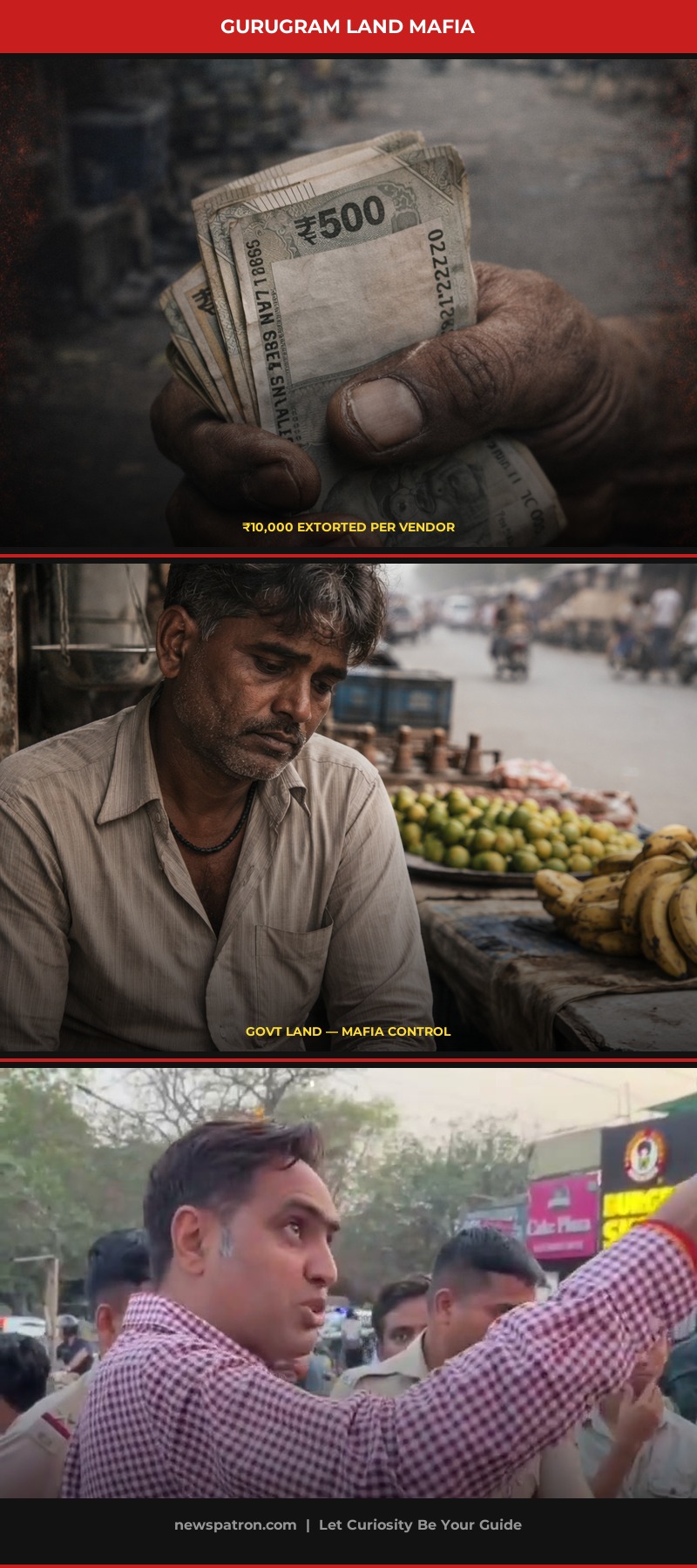
What Actually Happened on That Gurugram Footpath
An official — from the Municipal Corporation or local administration — confronted a street vendor about the spot he was operating from.
The questions were direct. Who owns this land? How long have you been here? And — most importantly — who are you paying?
The vendor’s answers were calmer than they had any right to be.
He had been there two years. The land, he confirmed, was government land — not private, not leased, not allocated. Government land.
And yet, every month, he paid ₹10,000 to someone who had appointed himself the landlord of public property.
When asked why he paid without seeking proper permission, the vendor said something worth reading twice: he paid because everyone around him was paying. That was the system. Not an exception. The system itself.
The official asked the most important question of the conversation: whose land is this? And when the vendor confirmed it was government land, the follow-up landed hard — then why is someone collecting money for it? Is this hooliganism?
The vendor’s reply, quiet and matter-of-fact: yes, basically, that is what it is.
Two years. Government land. ₹10,000 a month. To someone whose name the vendor knew, whose number he had, and who was not present in that conversation — because the mafia operator never is.
The Official Was Shocked. But People in Gurugram Were Not.
The moment this incident came to light through our sources, the response from local residents and Gurugram observers was immediate — and it was not surprise.
The dominant reaction was recognition.
People who know the city said plainly: this has been the reality in HUDA Market areas for years. Officers know. The administration knows. The money does not stop at the mafia. It travels — to police, to municipal corporation officials, and, some allege, to political contacts who ensure the arrangement stays undisturbed.
One local resident who regularly passes through the affected area put it simply: the officer asking the right questions is not the problem. The problem is that the person actually collecting the money was not in that conversation — and that is not an accident.
Others pointed to a specific, recurring pattern: enforcement action almost always lands on the vendor. The stall gets demolished. The vendor loses his livelihood. The mafia operator who was charging him faces nothing, because there is no record, no receipt, no evidence chain that the administration chooses to follow.
A local civic observer who tracks such issues in Gurugram noted that one honest officer doing the right thing is visible — but he is alone. What Gurugram actually needs is ten such officers working in coordination, with the backing of a system that rewards accountability rather than penalising it.
That is the gap between a viral moment and actual change.
How the Mafia Actually Operates and Why It Persists
Let us be precise, because vague outrage does not help anyone.
Government land — roadsides, public squares, HUDA plots, civic footpaths — exists across every city in India. It is not always clearly demarcated. It is not always being actively used. And it is not always being monitored.
Into that gap steps the mafia.
Not dramatically. Not with visible muscle. With a simple arrangement. Someone controls the informal allocation of spots on that land. They charge a fee. Vendors who pay get to operate. Vendors who refuse find their space reassigned, or face regular disruption until they comply.
Local sources familiar with how this works in Gurugram describe it bluntly: the vast majority of vendors operating on government plots in certain areas are under this network. It is not a choice most vendors feel they have. Stop paying and you are gone the next day.
And here is the part that people who know the city keep saying, quietly: the money does not stay with the street-level mafia. It moves up the chain — portions reaching local officials, police contacts, and political networks that provide the protection the arrangement needs to survive.
Which is why the vendor knew the name and number of the person he was paying. Which is why he had been paying for two years. Which is why he answered the official’s questions with complete calm — because in his experience, this conversation had happened before and nothing had changed.
Kya Aapke Shahar Mein Nahi Hota
Let us ask the question directly.
Do you think this is a Gurugram problem?
The same structure — government land, informal permission fee, mafia allocation, administrative silence — operates in Mumbai’s hawker zones, Delhi’s roadside markets, Kolkata’s pavement stalls, Chennai’s fish markets. The fee varies. The model does not.
In Mumbai, sources tracking hawker extortion put the going rate for prime footpath spots between ₹5,000 and ₹15,000 per month. In Delhi, roadside permission fees have been documented repeatedly by civic journalists. Bihar saw exactly this dynamic in December 2025 — vendors demolished while the mafia that collected from them faced no parallel action.
In Haryana alone, within the same week in March 2026, a separate but structurally identical story emerged: the timber mafia in Panchkula’s Khair Forest cleared more than 10,000 trees in a single night. The outcome? A forest guard was suspended. The mafia operators who orchestrated it were not.
The pattern is consistent. Enforcement falls on the visible end of the chain — the vendor, the tree, the encroachment. The invisible end, where the money actually goes, remains untouched.
The Exhaustion of People Who Already Knew
The reaction from those tracking this situation in Gurugram and across India was not shock. It was the particular exhaustion of people who have seen the same story too many times.
Some expressed it as sarcasm — if the police also take a share, why would anyone be surprised? Others put it as a structural observation: when everything from land to vegetables to newspaper distribution has a mafia, why would government land be different?
A few focused on the specific hypocrisy of officials confronting vendors for paying the mafia, while the mafia operator who received the money was never in the room.
The sharpest observation, repeated in different forms by multiple people following this: it is easy to go after the poor vendor who is visible, compliant, and powerless. It is considerably harder to go after the person at the other end of the ₹10,000 — the one who has relationships, political cover, and the institutional knowledge of exactly which line not to cross.
That person was not in the conversation. That person is never in the conversation. And until they are, the conversation changes nothing.
What Should Actually Happen
Since we are here, let us be specific.
- GIS mapping of all government land at the municipal level, publicly accessible. Any citizen should be able to verify whether a given plot is government land and whether it has a legal occupant.
- A public permit system for vendor spots. Transparent, time-bound, digitally issued. The fee goes to the municipal corporation — not a middleman. The vendor gets a QR-coded permit they can show any inspector.
- Anti-extortion reporting at the ward level. A phone number that does not route to the same administration the complaint is about.
- Accountability for the allocator, not just the vendor. Every encroachment raid that does not result in an investigation of who was collecting money from the encroachers is incomplete. It is enforcement theatre, not enforcement.
Right now, Gurugram has one officer asking the right questions. That is a beginning. It is nowhere near a solution.
Government Land Is Your Land
Not in a philosophical sense. In a legal, constitutional sense.
Every square metre of government land in Gurugram belongs to the public.
When the mafia charges ₹10,000 for access to it, they are not just extorting a poor vendor. They are charging you for your own property.
And when the administration is shocked — genuinely shocked, or performing shock for the camera — neither outcome is acceptable.
Either they did not know, which means they were absent.
Or they did know, which means they were complicit.
Both explanations lead to the same outcome: the vendor pays, the mafia collects, the official looks surprised, and tomorrow morning everything continues as before.
The vendor who paid ₹10,000 for two years is still out there. The mafia operator whose name and number the vendor knows has not been named in any official complaint, as of March 23, 2026.
No arrests. No official statement from the Haryana government. No policy response.
Just the question the official asked on camera, hanging in the air unanswered: Is this hooliganism?
Yes. Basically, that is what it is. The vendor said so himself.
Follow Newspatron for updates as this story develops. If you have information about similar extortion in your area, write to us at newspatron.com.
Video credit: @MissionAmbedkar. Used for public interest news commentary. Newspatron — Let Curiosity Be Your Guide.
