



Editorial Note: This article is based on CCTV footage, publicly
circulated bystander video, and reporting by Aaj Tak (18 March 2026) and Gujarat
Samachar. Named individuals — PI R H Solanki and Jahu Shankar Thakor — are confirmed
in official records and published reports. All legal analysis is editorial opinion.
Footage is used for public interest journalism.
Subscribe to Newspatron on YouTube — Let Curiosity Be Your Guide.
Twenty people. Sticks, swords, sickles, stones.
One police van. Retreating.
That is how the story began in Jhiliya village, Chanasma taluka,
Patan district, Gujarat, on the night of 15 March 2026.
A temple donation dispute at a farmhouse turned into a coordinated mob assault on
a 112 emergency response team. The CCTV caught every second of it. The footage
spread nationally within hours.
But that is not where the story ended.
Within 48 hours: 18 accused arrested. Officers suspended.
Accused publicly paraded — hands tied with rope, beaten with lathis on the same
road where they had attacked the police van, made to perform uthak-baithak in public
view. Crime scene reconstruction at the same farmhouse. A Patan Court remand until
23 March 2026.
This story has more than one angle. Every angle deserves examination without flinching.
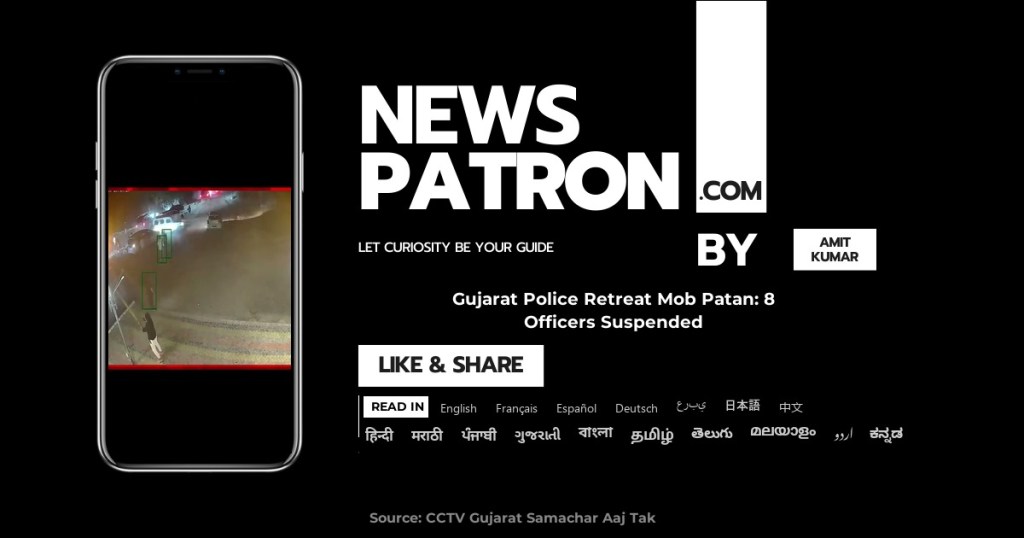
Gujarat Police 112 team retreats from armed mob — Jhiliya village, Patan district, Gujarat, 15 March 2026. 18 arrested, 8 officers suspended. Edited short. Published by Newspatron for public interest journalism.
Gujarat Police Retreat Mob Patan: What Happened in Jhiliya
The 112 call came in on 15 March 2026. A dispute over temple construction funds
at a farmhouse in Jhiliya village, Chanasma taluka, Patan district.
Routine enough to generate an emergency response.
What the team found at the farmhouse was not routine.
Approximately 20 individuals — armed with sticks, swords, sickles,
and stones — were waiting. The mob attacked the arriving police van, pelting it with
stones and forcing officers to fall back. The CCTV mounted at the farmhouse recorded
the retreat in full.
That footage is what spread. That footage is also what made retreat impossible to
deny — and impossible to ignore.
The officers regrouped. They returned with reinforcements. By then the calculation
had changed entirely — for the mob, and for the Gujarat police command that had just
watched its own team retreat on a viral video.
The Temple Donation Dispute That Was About Much More
The immediate trigger was a chanda vivad — a dispute over temple
donation funds. But a dispute over funds does not produce twenty armed men, multiple
weapon categories, and a coordinated assault on police — unless the dispute is sitting
on top of something older and more dangerous.
Police investigation identified the underlying fuel: a local gang
rivalry involving factions active in the Chanasma-Patan area. The temple
donation dispute was the flashpoint. The gang structure was the accelerant.
The main conspirator arrested is Jahu Shankar Thakor — one of
18 total accused taken into custody. According to Aaj Tak (18 March 2026), the armed
crowd arrived suddenly at the farmhouse, damaged the gate, and launched the assault
on the arriving police team.
The organised nature — the weapons, the numbers, the willingness to attack
uniformed emergency responders on camera — is consistent with a group that had prior
structure and a prior calculation that the risk was manageable.
That calculation was spectacularly wrong.
18 Arrested: The Retreat That Became a Reckoning
The arrests came fast. All 18 accused — including Jahu Shankar Thakor —
were taken into custody. Police then went beyond standard post-arrest procedure.
The accused were brought back to Jhiliya village. To the same farmhouse.
A full crime scene reconstruction was conducted — retracing the
sequence of events to build the evidential record for the charge sheet.
But before that came what witnesses described as mahaprasad.
The accused were paraded on the road. Hands tied with rope.
Officers present with lathis. The accused made to perform
uthak-baithak on the public street, in front of onlookers
from the same village where they had chased away a police van 48 hours earlier.
Raw footage: CCTV police retreat + daylight arrest parade — Jhiliya village, Patan district, Gujarat, March 2026. Credit: Gujarat Samachar / Aaj Tak / bystander footage. Published by Newspatron for public interest journalism.
The Public Parade: Order Restored or a Line Crossed?
This is the part of the story that demands honest editorial comment.
The public parade — hands tied, paraded, made to do squats on a public road —
is not a formal part of the Indian criminal justice process. It is not sanctioned
by the Bharatiya Nagarik Suraksha Sanhita. It is, technically, extrajudicial
punishment administered before conviction — or even before a charge sheet.
What it is: A display of force by a department publicly
humiliated 48 hours earlier. A message — delivered in the same village, on the
same road — that the retreat was temporary and the consequences were real.
Deterrence operating entirely within the language the local gang structure
understands.
What it is not: Due process. Legally sanctioned.
Usable as evidence in court. A substitute for a charge sheet or conviction.
Both things are true simultaneously. The mob was wrong to attack police.
The manner of the public parade sits outside the law — regardless of what
the accused did. Accountability must be consistent. Or it is not
accountability at all.
Patan Court: 5-Day Remand and What the Charge Sheet Must Reflect
All 18 accused were produced before Patan Court.
The court granted a 5-day police remand until
23 March 2026.
The charge sheet must reflect, at minimum:
- Assault on public servants — specifically the 112 emergency
response designation of the attacked team. - Unlawful assembly with deadly weapons — swords, sickles,
sticks, stones; the threshold for organised armed assembly is clearly met. - Obstruction of public duty — the attack was specifically
directed at preventing police from performing their function. - Criminal damage — to the farmhouse gate and police vehicle.
- For Jahu Shankar Thakor — charges reflecting planning and
organisation, not just participation.
Bail opposition at every stage — for all 18, especially the main conspirator —
is not optional. If remand is followed by bail within a fortnight, the message to
the gang structure is indistinguishable from acquittal.
Gujarat Police Suspensions: 48 Hours, 8 Personnel, No Hesitation
This is where Gujarat’s response diverges sharply from the national pattern.
Eight personnel — including PI R H Solanki, one ASI, one Head
Constable, and five GRD jawans — were suspended or dismissed within 48 hours of
the footage spreading.
In most states, this video would have triggered managed silence, a quiet inquiry
that runs for months, and eventual transfers to less visible postings.
The video fades. The officers remain. Nothing changes.
Gujarat chose differently. The signal delivered in those 48 hours:
retreating from a mob without exhausting available options is not
acceptable. Not on camera. Not without consequence.
No Matter How High You Are — You Are Never Above the Law
Justice on the Streets: How Surat’s Notorious Loan Shark Got a Reality Check
from the People He Terrorized
Gujarat Police Retreat Mob Patan: What Comes Next
The remand runs until 23 March. The gang rivalry probe is open.
The follow-through must look like this:
- Charge sheet by the 23 March deadline — not an extension.
- Active bail opposition for all 18, especially Jahu Shankar Thakor.
- Gang rivalry investigation as the primary inquiry — not a footnote
to the temple dispute. - Internal probe on the public parade — who ordered or permitted it.
- Departmental proceedings for suspended officers — concluded within
a defined timeframe, outcomes publicly communicated. - Sustained police presence in Jhiliya and the Chanasma belt —
not just until the media cycle ends.
The CCTV did its job. The bystander cameras did their job. The question now is
whether the courts, the probe, and the departmental process will do theirs —
in the weeks after the cameras stop being watched.
Where Is Patan in Gujarat?
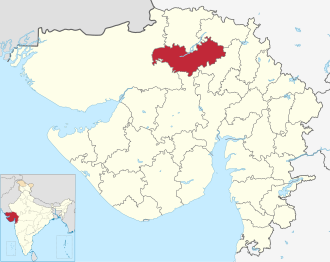
Patan district is located in northern Gujarat, approximately
125 kilometres north of Ahmedabad. The district headquarters is Patan city —
historically significant as the former capital of the Solanki dynasty and home
to the UNESCO-recognised Rani ki Vav stepwell.
Chanasma taluka, where Jhiliya village is located, sits within
Patan district along the Patan-Mehsana belt — predominantly rural, with agriculture
as the primary livelihood. The Chanasma region has seen periodic incidents of
land and community disputes escalating into organised group violence — a pattern
consistent with the temple donation dispute that triggered the March 2026 incident.
Patan district falls under the jurisdiction of the Gujarat Police’s
Patan Superintendent of Police office. Chanasma police station
handles law enforcement for Jhiliya village and surrounding areas.
Uncut Footage
Stay in the Loop with Newspatron
Kumar, Editor at Newspatron, wants to hear your take.
The police retreated. Then they came back. The 18 accused got their mahaprasad.
8 officers face departmental action. But the public parade — was that justice,
or a different kind of problem? Drop your comments below.
- 📲 Quick updates: Follow Newspatron on Instagram, YouTube, and Reddit.
- 💬 Deeper conversations: Connect on Facebook. Real profiles only.
- 🎥 Drone footage: DroneMitra on YouTube —
youtube.com/@dronemitra —
Shorts and
Videos. - 📣 Instant alerts: Newspatron WhatsApp Channel. Your number stays private.
- ⚡ Quick chats: Telegram.
- 🤝 Professional network: LinkedIn.
All links on the Newspatron homepage. See you there.
The mob won round one. Round two belonged to accountability.
Comment “MAHAPRASAD” below. 👇
